


Slap Shot (1977): The Greatest Hockey Movie Ever Made, and the shoot that can't happen again (legal said so)!


On April 10, 2025, a dedicated cabal of Showbiz Hobos from around Toronto gathered at The Firkin on Danforth in Toronto to watch the greatest sports movie ever made, 1977's Slap Shot! A Showbiz Hobo screening is never a simple viewing. It's essential to do a deep dive into what it takes to make a gem like Slap Shot, from the cast to the crew working 14+ hours on ice!
For your reading pleasure, this post is based on the research and presentation from the Showbiz Hobo Screening of Slap Shot. Thanks to Carmelo and the staff at the Firkin for having us. Keep following the website and us on Instagram, YouTube, and Substack for the next one!
-Paul
The Plot
The Charlestown Chiefs are the worst team in the Federal League. Player/Coach Reggie Dunlop is desperate to keep the team from folding. He needs the Chiefs to win, so he can fill seats in the arena. His solution: turn a bunch of lovable losers into the most violent, crowd-pleasing goon squad in the League. Sort of. Slap Shot is the funniest, filthiest, layered hockey movie ever made — and one of the great American sports movies, full stop. The production of Slap Shot is also as raw and unfiltered as the movie itself.

OWNS! OWNS! The Origin of Slap Shot
Slap Shot has its origins in a drunk dial.

It's 1974. A minor league hockey player named Ned Dowd is playing for the Jonestown Jets in the Federal League. Ned had a great college career. He played D2 NCAA Hockey for Bowdoin College and scored 43 goals in 3 years. Now he's on the Jonestown Jets, riding at the bottom of the standings. The mill in town is shutting down. The team is probably going to fold. So Ned and his teammates do what hockey players do in that situation: they go out and get absolutely hammered.
Somewhere in the early AM, Ned drunk-dials his big sister Nancy.
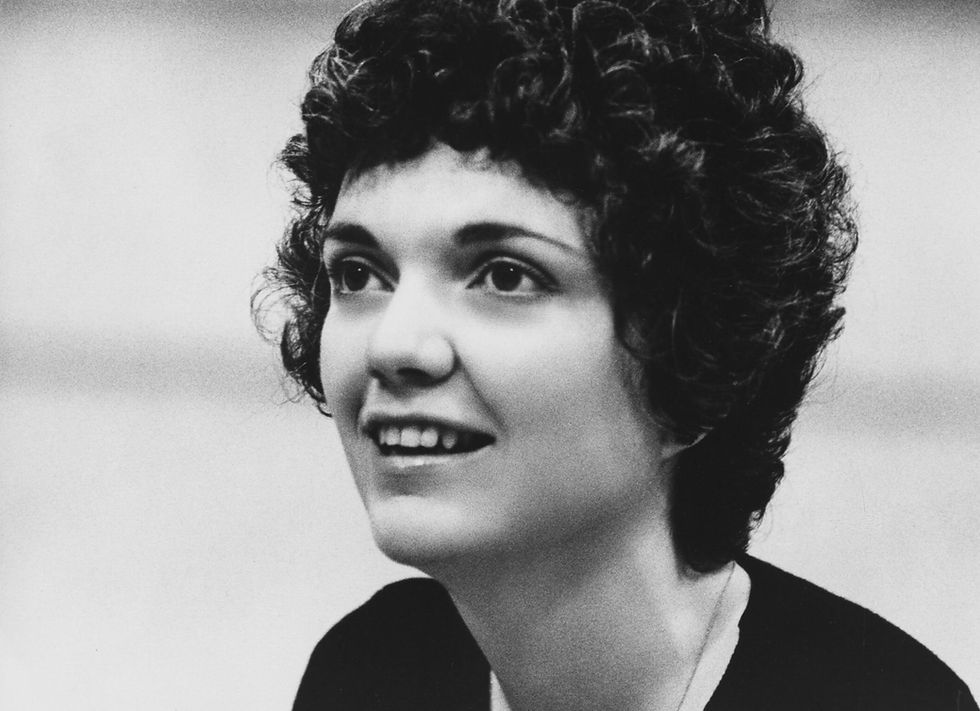
Nancy Dowd had graduated from Smith College with a degree in French, completed her Master's at UCLA, and was taking her first real stab at writing. She'd been listening to Ned's stories from the minors for years. But that night on the phone, Nancy asks....
"Who owns the Jets?" she asked.
Ned didn't know.
"At that moment," Nancy later said, "I knew I was going to write the screenplay that would become Slap Shot."
Nancy packed her bags, moved to Johnstown, and spent three months living the life — riding the bus with the team, going everywhere they went, recording everything on tape. She wrote and rewrote. The script circulated through agents in LA. Directors came and went. George Roy Hill got hold of it, loved it, couldn't get it off the ground, and eventually moved on.
At various points, James Caan, Burt Reynolds, and most interestingly, Al Pacino were attached to play Reg Dunlop.

Eventually, the script found its way to Paul Newman. Newman was the biggest star in Hollywood through the 1960s. Movies such as Butch Cassidy, The Sting, and The Towering Inferno had shown Newman's versatility and bankability. Also, witness’s note, Newman could also pound a case of beer a day. Newman loved it and corralled George Roy Hill to direct. From there, they started putting together the rest of the team.
Pre-Production: Where You Have Work Stress Dreams About Days You Haven't Shot Yet
There are all sorts of stories about the casting of Slap Shot, but the two most interesting are those of Melinda Dillon and Michael Ontkeen.

Melinda Dillon — yes, Ralphie's mom from A Christmas Story and Close Encounters of the Third Kind — was given the choice between the role of Francine, Dunlop's estranged wife OR Suzanne Hammerhan. She chose Suzanne, the smaller role. Why? In her words, "It was the only chance she'd ever get to do a sex scene with Paul Newman."
Respect. I mean, mission accomplished!
Michael Ontkean came in to audition for Ned Braden, the talented but principled young player at the
centre of the team's moral conflict. Ontkean was a child actor who had gone on to play D1 NCAA hockey on scholarship at the University of New Hampshire, where he led his team in scoring in his junior year. When Slap Shot came around, he was fixing motorcycles in Maine and hadn't worked in two years.
He auditioned at an arena in Burbank and beat out a who 's-who of guys who went on to become enormous stars, including Richard Gere, Harrison Ford, John Travolta, Nick Nolte, Kurt Russell, and Tommy Lee Jones.
The studio didn't want him. Newman lobbied hard and eventually wore them down.
I reached out to a contact I had for Ontkean's agent about our screening. He got back to me himself — not the agent, the man — with an essay you can read by clicking here. Here's what he wrote about Newman:
"After reading for George Roy Hill on multiple occasions, and then for various Universal executives, I was rejected every single time. Paul never wavered in his support... Paul is a tenacious giver with a heart of rowdy and unbounded generosity. He finally wore down the director, all the producers, and the studio brass. Clearly, I owe my childhood hero just about everything; a man who was always genuine, always devoted to excellence rather than to the shallow appearance of it."
If that doesn't get you, I don't know what will. It's a terrific piece.
When Ontkean showed up to shoot, he brought his own gear. Most of the pads worn by the other players in the movie look relatively new. His pads are browned with experience.
The Hansons
After a brief and futile search for actors who could play hockey, in addition to Ontkean, George Roy Hill made a pragmatic and inspired determination: it was easier to turn hockey players into actors than the other way around.

Enter Jack, Steve, and Jeff Carlson, who played for the Johnstown Jets alongside Ned Dowd. They knew all the arenas featured in the movie like the backs of their hands. They knew every team, every rink, every dive bar in every town. They lived and breathed it. They brought a grit and an authenticity to those roles that no amount of coaching could manufacture.
Jack Carlson got called up by the Edmonton Oilers before production started, so they brought in Dave Hanson to fill out the trio — and the Hanson Brothers were born.
As stated above...the Hansons are not actors. They are playing a part, yes. But they ARE NOT actors. And that's exactly what makes the movie work. Those goofy, thick-glasses, foil-wrapped-hands weirdos are real. The grit is real. The movie wouldn't be the movie without them.
All of the other players on the ice were actively playing for other teams during the shoot. Scenes had to be scheduled around actual games. Everything was coming together for the shoot! This brings us to....
Production: Where Your Dreams Go to Die
This is a road show. You're flying 95% of your crew in from LA to shoot on location, which is just a slog. Every night you're loading trucks, or if you're lucky, you're pushing carts somewhere safe and sheltered. That said, shooting in real arenas during the hockey season means you're clearing out for games and working around someone else's schedule constantly.

Bobby Rose, the Key Grip, had the hardest job on the show. Most of the on-ice shots were captured with an operator in a wheelchair. They also built a custom sled with runners on it to get the camera super low to the ice. And they mounted a camera on a lawnmower. The results speak for themselves; the action on the ice in Slap Shot brings you seamlessly into the action.
Rick Sharp did the makeup — and it is absolutely some of the best blood work of the era. The bruising and bloody lips look absolutely fantastic! Makeup artists take tons of photos to keep continuity from scene to scene. In the age before digital photography, they had to rely on binders full of Polaroids. Just look at the bandage that ends up on Dunlop's neck as the movie goes on. A beautiful small detail.
It would be fair to say that Rick and his makeup team would have had the most challenging work of any department on this film. Rick went on to work on Top Gun, Flashdance, and Forrest Gump. Ya know....small-time stuff. This makes the next paragraph a little infuriating.
Rick is also, by the way, 5'2". The Hansons tied him up, stripped him down, and hung him on a hook. Sounds hilarious to read about it nearly 50 years later...but it's really just assault.
If you are an actor, production is a lot of waiting....I mean A LOT OF WAITING! Professional actors are used to this; many say you are paid to wait. The area for the cast to wait is called the Green Room. The Hansons would never wait in the Green room. For 2nd AD Peter Burrell, whose job it was to bring the cast in when the set was ready, it was a whole other ordeal. He had to put guards on his skates and head down the street to the bar to find the Hansons and bring them back to set. Burrell laughed at this in a recent appearance on the Stripped Zebra's podcast. But at the time, this would get old FAST.
At the Hyannisport game — the sequence where the Hansons jump into the stands — they cut up their hands climbing the glass. That's real. They also pinned down Jerry Houser and gave him "the shave," which is apparently a genuine old hockey tradition, but not typical of the workplace.
Something that everyone had to do was spend time on the ice. Like 12+ hours on the ice. According to Burrell, when you are on ice for that long, the cold comes up your leg and all the way to your groin. The production had to call Bauer to make special skates for the crew.
Also, FUN FACT! The shot where Braden checks Brophy into the boards and Brophy, uh, loses bladder control took 13 takes. With non-actors who don't know how to hit a mark, everything takes longer. Production is tough!
Newman's Antics
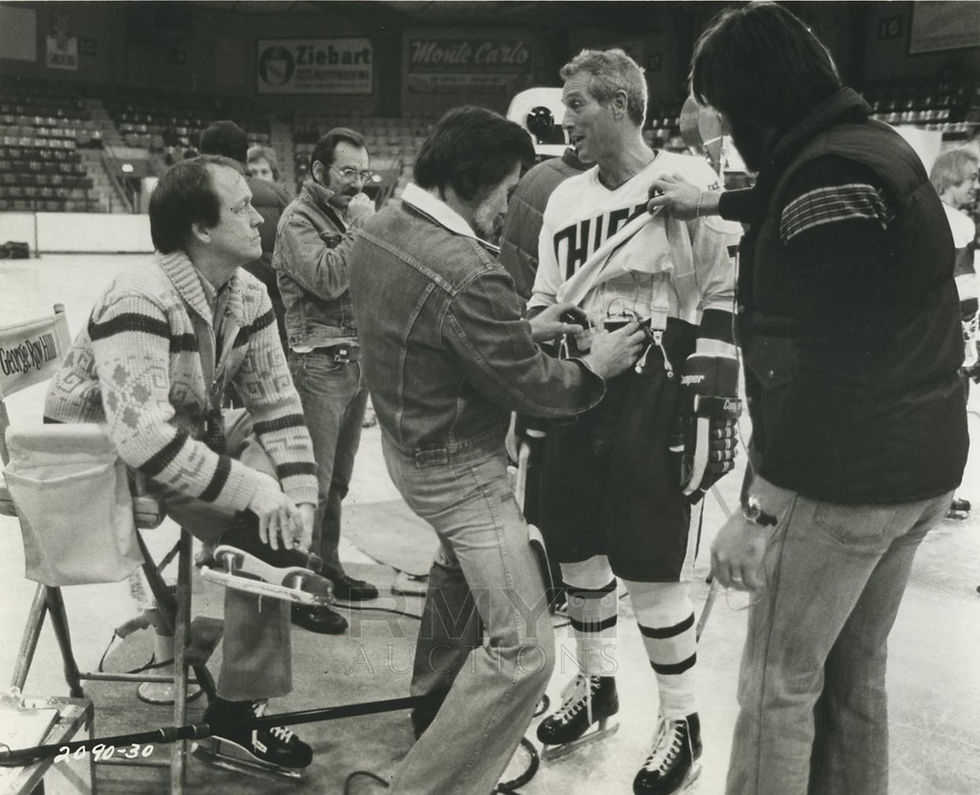
Paul Newman, at this point, was also a serious competitive racecar driver. He knew how to handle a car. He also had a long history of pulling pranks.
While shooting the scene where Dunlop drives to Braden's house, Newman came up with a plan. He starts going on to director George Roy Hill about how the car's accelerator is giving him trouble, but he thinks he can manage. He quietly talks the crew into throwing equipment and junk across the road just after the car disappears around the corner — so when he drives out of frame, it looks like he was in a massive crash.
George Roy Hill runs over to check on him and finds a large portion of the crew and Newman laughing hysterically.
Hill is absolutely furious! He calls the producers and wants everyone fired and on planes going home that night.
Newman went to Hill's house, and they had a genuine heart-to-heart. Hill and Newman had been friends for years. Newman threatened to walk with the crew. All was eventually forgiven. Newman stopped pranking his colleagues. Tensions eased. The atmosphere became, by all accounts, joyful.
Newman also had 100 cases of Coors beer brought in for his personal consumption. Which tracks.
Given a budget of $6 million, the film came in at $6.3 million. Nothing a studio would balk at.
The Winner of All This
Ned Dowd — the drunk-dialer, the source, the reason any of this exists — played Oglethorpe in the film and served as technical advisor throughout the shoot. He went on to work as an AD, Production Manager, and Producer on some very large films. He's probably the biggest winner of Slap Shot.
According to Ned:
"I think, to a man, anybody who worked on Slap Shot can say it was probably the most fun they've ever had on a picture. It was a good party, and nobody took it too seriously. In those days, there wasn't so much on the line, so you could enjoy yourself. These days, there's so much money out there, and there's so much at stake every day. The business has gotten — well, you're not allowed to have fun, I'll put it that way."
Where Are They Now
I reached out to agents and reps for everyone still alive. I heard back from Michael Ontkean and Lindsay Crouse — not their reps, them personally.
Lindsay Crouse emailed back in the middle of a terrible flu:
"Slap Shot was tremendous fun to make. Working with Paul Newman was delightful, and he always treated me as a fellow player, an equal. That put me at ease, and we had great fun together."
What the Movie Is Actually About: The Failure of Masculinity and the Victory of Femininity
"This movie predicted a lot. Helmets, Florida hockey, lesbian goalie wives."
-Steve Carlson, Slap Shot commentary
He's not wrong. But let's go a layer deeper, Nancy Dowd deserves it. She also wrote North Dallas Forty, one of the best football movies ever made. She understood what these sports really are.
Slap Shot is a movie about the limitations of masculinity.
The mill in Charlestown is shutting down. The most masculine profession in town and the lifeblood of the community is disappearing, and taking the town down with it. The Chiefs — these men whose whole identities are built around this game — cannot save it. They don't even pretend that they can. It's an impossibility. The plan from the beginning is to get sold and move on, not to save anything. To fill the stands, they need to win. To win, they resort to goonery!
And their victory at the end doesn't save the town. It doesn't save the team. Maybe it gives them somewhere else to go. Maybe.
For the women in the film, hockey is a drag. It's holding them back.
Suzanne starts sleeping with women. Hanrahan beats her for it. She's stuck drinking herself into oblivion.
Lily is a wreck throughout — constantly hammered, wearing drab men's clothes, and hates her husband. The moment she turns herself around for good is when Dunlop takes her to Francine's salon, and she gets a makeover — she begins to reclaim something she'd buried, her femininity. After that, she's broken out of the mould; she's rejuvenated.
Francine is an entrepreneur. She has her own business. She doesn't need Dunlop. But she's given him every chance and eventually reaches her limit.
The Chiefs win the championship game when Ned Braden skates out and does a striptease — a deliberately vulnerable and defiantly feminine act. It enrages Tim McCracken, who strikes a referee. The ref calls the game for the Chiefs. Masculinity, taken to its violent extreme, defeats itself, leaving femininity to reign supreme!
This brings us to the last shot of the movie, where the story ends — Francine leaving Charlestown. She has one last chat with Dunlop as she is driving through the parade on her way to a new life. Dunlop is trying to talk about his next job in Minnesota, and how he's gonna bring all the other players with him. Francine is over it. She's not angry. She doesn't hate him. She's just done. Jennifer Warren later said, "I had the most difficult job on the whole film. I'm the girl who breaks up with Paul Newman."
The camera cuts to Dunlop watching her go, and he begins to realize she's outgrown him and is leaving his life for the last time.
The Jist
Slap Shot holds up. It holds up as a comedy, as a sports movie, as a piece of 1970s social realism, and as a surprisingly sharp feminist text hiding inside the most profane hockey movie ever made. It's also why the sequels are infinitely forgettable. Slap Shot is the greatest sports movie of all time because of Nancy Dowd's feminine perspective.
Put it on. Bring beer. Thank you, Ned Dowd, for that phone call.
This article references Michael Ontkean's piece Coach, Teammate, Linemate, Chirping Zebras Podcast Ep 37: Interview with Peter Burrell, The Making of Slap Shot: Behind the Scenes of the Greatest Hockey Movie Ever Made, and the DVD Commentary of Slap Shot by Steve and Jeff Carlson and Dave Hanson.
Fair Use / Fair Dealing Notice:
Showbiz Hobo uses copyrighted material under Fair Dealing (Canada) and Fair Use (U.S.) for purposes such as criticism, commentary, education, and review. All rights remain with their respective owners. Content is used thoughtfully, with credit given where possible. Concerns? Contact showbizhobo@gmail.com.


Comments